



Nearly two-thirds of Singapore Gen Z say they lack confidence in managing money, despite information being easier to access than ever before. If you work in financial services or fintech, you’ve probably seen the industry’s default response to this: build another literacy programme, add a financial education tab to the app, commission a “how to budget” content series.
Across four distinct behavioural personas — mapped from primary research with Singapore Gen Z — the data tells a consistent story: this generation is not financially ignorant. They are behaviourally unsupported. And there’s an important difference.
“It's not about what they know. It's about what's easy for them to do. The problem is not knowledge. It's design.
The dominant narrative in financial services frames GenZ as impulsive, debt-reliant, and financially immature. The BNPL boom is frequently cited as evidence. Research from Malaysia has pointed to impulsive spending and weaker financial skills as the primary culprits behind Gen Z credit misuse, and separate work on the region has characterised the cohort as especially vulnerable due to unstable incomes and limited financial literacy.
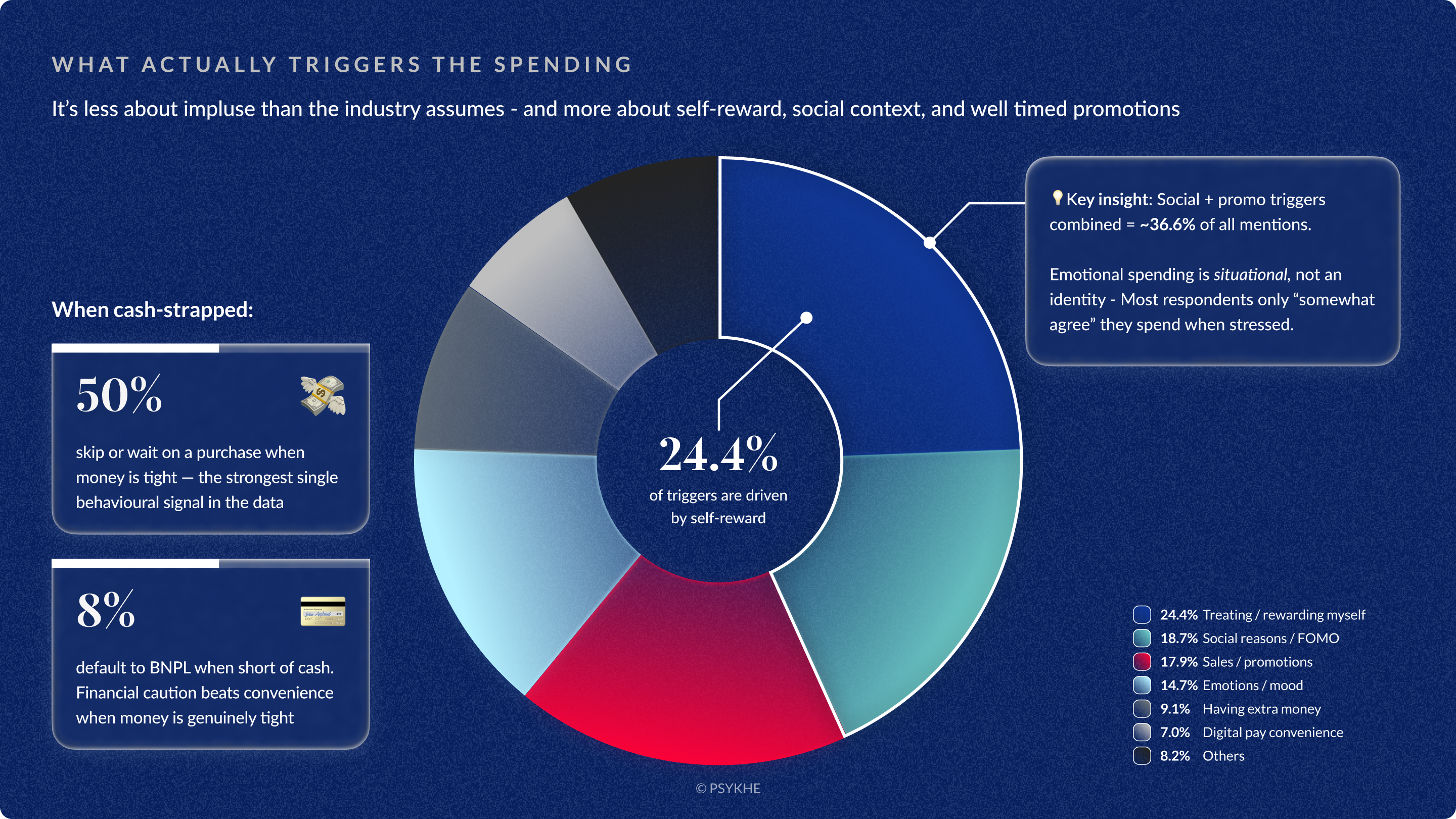
Singapore tells a different story. In our research, nearly half of Gen Z (48.7%) respondents save regularly — not occasionally, not aspirationally, but as a routine. When money is tight, almost 50% say they simply skip or wait on a purchase rather than borrow. The top spending trigger isn’t peer pressure or social FOMO, it’s self-reward (“I deserve it”), cited by 24.4% of respondents. That’s an intrinsically motivated, often conscious act. Not a reckless one.
And BNPL? Only 8% of our Gen Z respondents default toBNPL when cash runs short — a markedly cautious posture in a market where nearly a third of Singapore adults overall now use BNPL services. In stark contrast, comparable markets such as Australia, 59% of Gen Z and Millennial respondents combined reported using BNPL in the past six months. Singapore’s markedly lower penetration reflects a more conservative credit culture and the stronger financial caution observed among local Gen Z respondents in our primary research. Users largely understand the downside: a majority of BNPL users in our sample agreed it can lead to spending more than planned. They’re using it knowingly, not naively.
“The impulsive Gen Z narrative is a generalisation that doesn’t hold in Singapore — and building products for the wrong problem risks solving nothing.”
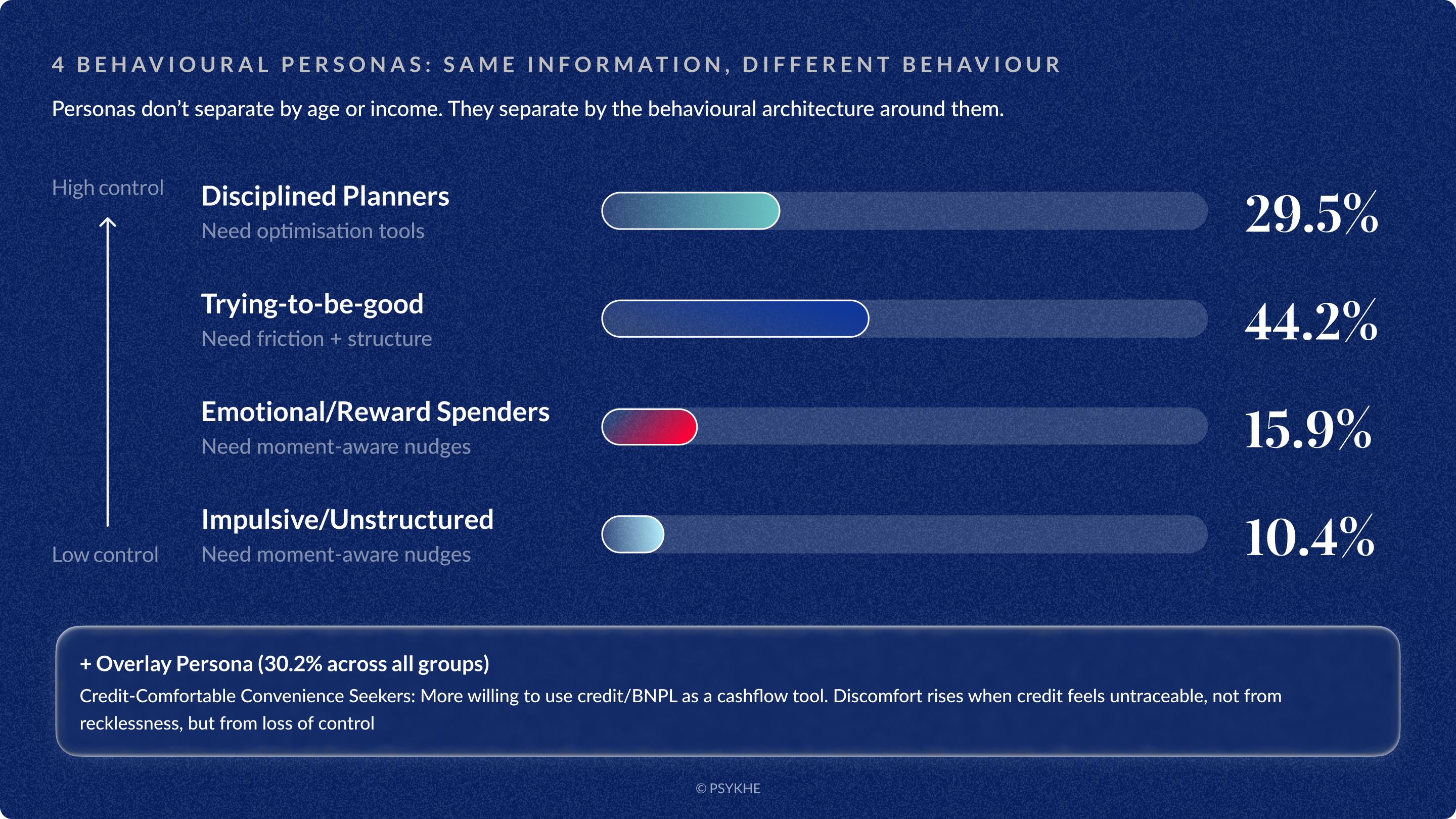
Before examining where behaviour breaks down, it helps to know who we're talking about. Our research maps Singapore Gen Z across four behavioural personas — from Disciplined Planners who largely self-manage, to Impulsive Spenders who operate on instinct. Our personas are not distinguished by age or income, they are distinguished by the behavioural nuances. The detail on each comes in the next section. What the pressure points below share is that they cut across all four groups to varying degrees — none of these personas is immune.
If it’s not ignorance or recklessness, what is it? Our data points to three pressure points where behaviour consistently fractures, none of which a financial literacy course can fix.
The emotional moment. Emotional spending is real, but it’s situational rather than defining. The largest response to “I spend money to feel better when stressed” was “somewhat agree”, not “strongly agree.” Emotional spending is more like a recurring vulnerability than a personality trait, such as rewarding oneself after completing a challenging project or when they manage to achieve a goal they set for themselves. Products that target the moment of stress, rather than labelling someone an “emotional spender”, will be far more effective.
The social and promotional trigger stack. When you combine social reasons and sales/promotions, they account for roughly 37% of all spending trigger mentions. Digital payments don’t cause this spending, they simply remove friction at the exact moment these triggers hit. The system makes acting on temptation easier than resisting it.
Decision fatigue and mental load. Even high-income respondents in our sample report difficulty managing money. The barrier, is not how much they earn; it’s cognitive overload. Singapore's own data supports this: a 2025 UOB/BCG survey found that 35% of GenZs failed to meet any of MAS’ four financial planning benchmarks; not from lack of information, but from a gap in consistent financial behaviour. Regional research reinforces the point: among three predictors tested in an Indonesian study — financial literacy, financial socialisation, and self-control — self-control emerged as the strongest driver of Gen Z financial management behaviour. Simplification tends to outperform higher returns as a motivator.
“Financial literacy fails at the point of emotional pressure, social context, and decision fatigue — not in the classroom.”
Our research segments Singapore Gen Z into four behavioural personas, but the more revealing insight is what doesn’t separate them. It’s not age. It’s not income. It’s not even how much they know about financial concepts. What separates them is the behavioural architecture around them: the defaults they encounter, the friction or ease in the systems they use, and the emotional and social context in which financial decisions get made.
The four personas, briefly:
The existing literature often treats financial literacy as the key mediating variable — improve knowledge, improve behaviour. Our data doesn’t support that model in isolation. A 2025 Bank of America study of 915 US Gen Z adults found that 72% had taken active steps to improve their financial health in the past year, yet over half still lacked sufficient emergency savings. The gap between intent and outcome is the story, not the absence of effort. Persona predicts behaviour better than literacy level: a Disciplined Planner with moderate financial knowledge will consistently outperform an Impulsive Spender with high financial knowledge, every time. The structural and emotional context matters more than financial education.
“The trying-to-be-good cohort — 44.2% of Gen Z — is the single biggest opportunity in this market. They want to do the right thing. They just need the system to make it easier than the alternative.”
The shift from 'educate them' to 'design for them' isn't abstract. It rewrites your product roadmap, your messaging, and your definition of success.

Make good behaviour the default, not a decision
Impulsive and unstructured spenders don’t respond to nudges that require them to act. They need defaults — auto-transfers on payday, spending caps pre-configured, round-up savings built into the payment flow. The design principle is simple: if the right behaviour requires effort, most people won’t do it consistently.
A practical audit: does your product know when payday is? If it doesn't redirect even a fraction of that incoming balance before the spending triggers hit, you've ceded the most important moment in your customer's financial month.
Use friction as a feature for the middle 44%
The Trying-to-Be-Good segment doesn’t need more financial education. They need structural resistance at the moment of temptation: a one-tap pause before a BNPL checkout, a real-time nudge when a purchase would exceed their discretionary budget, a 24-hour cooling-off rule applied to sale-day transactions.
Small, well-placed friction is not a bad user experience for this group; it’s what they’re asking for. They describe themselves as “trying to control my spending but sometimes overspending.” They want the system to help them hold the line.
Design for social, not solo
92% of our respondents agreed that seeing peers save motivates them to do the same —38% strongly so. 88% said talking about savings goals with friends helps them stay consistent — with 31% strongly agreeing. Yet most banking apps are built as entirely private, individual experiences; optimised for personal finance management, not for the social reality of how Gen Z actually relates to money.
The “loud budgeting” phenomenon, where individuals publicly share spending limits and savings goals, went viral precisely because it gave language to something this cohort already felt: financial accountability is more sustainable when it’s social.
This isn’t a passing TikTok moment, it reflects a core psychological driver for a cohort that financial products have almost entirely ignored.
Shared savings goals, peer-visible milestones, and social streaks are not gimmicks. They’re behaviourally grounded features that tap a motivation stream interest rates never will.
Target the moment, not the identity
Saving doesn’t fail during calm, rational planning sessions. It fails at 9pm on a Friday when someone has just been paid and a group chat is making plans. BNPL discomfort rises not from awareness of risk, but from the feeling of credit being invisible and untraceable.
The design implication is to intercept behaviour at the right moment; payday-triggered auto-saves, spending spike detection, real-time visibility of total BNPL commitments, rather than trying to build better financial intentions ahead of time.
Build trust before building content
One of the sharpest findings in our research is that GenZ’s financial confidence gap isn’t about lacking information, it’s about not knowing which information to trust. Even Disciplined Planners are only“somewhat confident” when it comes to identifying reliable financial advice online. Heavy social media use correlates with lower trust confidence, not higher, because the volume of conflicting advice can create decision paralysis and confusion rather than clarity.
For regulated financial institutions, this is a competitive advantage — if deployed correctly. The edge isn’t producing more content. It’s credibility, plain language, transparency about trade-offs, and using relatable peer narratives rather than authoritative financial voices. Authenticity is more compelling to this cohort than authority.
“Institutions that redesign around trust and behavioural context, not financial literacy content, will be the onesGen Z actually engages with.”
The opportunity is not evenly distributed. Disciplined Planners, roughly 30% of Singapore Gen Z, are already largely self-sufficient. They need optimisation tools and better product yields, not behavioural intervention.
The real prize is the Trying-to-Be-Good cohort: 44% of Gen Z, financially conscious, motivated, and structurally underserved. They want to save more, spend smarter, and feel in control of their money. They just keep getting derailed by systems that make the wrong behaviour easier than the right one.
Small structural nudges — a well-placed default, a moment of friction, a social layer on top of a savings product — can move a meaningful share of this cohort toward more consistent, disciplined financial behaviour. That’s not a product feature. That’s a market development strategy.
The institutions that win Gen Z's trust and lifetime value will be the ones that ask a different question. Not 'how do we educate them?' but 'how do we design systems where the right behaviour happens by default?' Designing for the latter leads to better products, stronger engagement, and ultimately, a generation that builds financial habits through repeated successful actions.
If your 2026 roadmap still includes a financial education module as the answer to attract or keep Gen Zs in your product, you may already be behind.
This article draws on primary research conducted by PSYKHE with 353 Singapore Gen Z respondents (ages 16–28), mapped across four behavioural personas. The research examined saving habits, spending triggers, BNPL usage, financial literacy, confidence, and credit comfort.