


Most AI rollouts are measured by how many people log in. If you lead digital or AI work in a bank, insurer, or government agency, you’ve probably heard what comes next: build AI into the tools people already use, and usage will stick.
We expected our research to back that up. It didn’t. Of the 8 daily AI users we interviewed, one dropped Copilot even though it sat inside the Microsoft tools she used all day. Three others chose tools that weren’t built into their software at all.
Two questions decided whether a tool stayed: Was the output good enough to use? Was someone else paying for it?
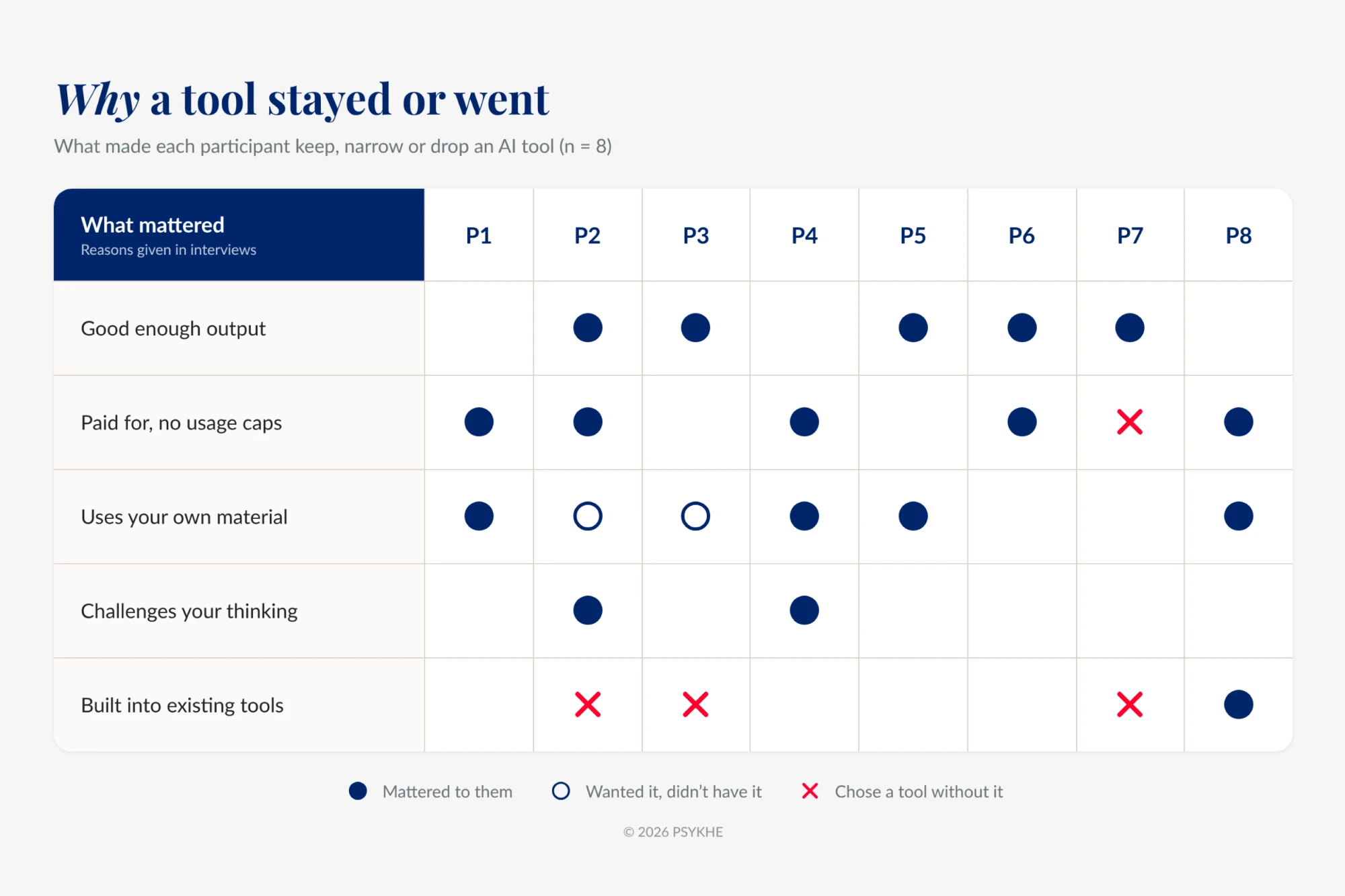
Good enough output. Five of eight participants judged a tool on whether they could use what it produced. Fast drafts that needed heavy rework lost their place.
Paid for and approved. Five used whichever tool their employer already paid for, with no usage caps. Procurement and policy shaped adoption alongside product quality.
Grounded in their own material. People trusted AI more when it worked from their documents and showed its sources. One participant found Claude kept adding terms she had never used. She limited it to her own files, which left less to check, and she kept using it.
"The tools that lasted produced work people could use, and someone else paid for them."
Three participants used AI tools that their organisation hadn’t approved. One described their team’s habit as using ChatGPT first and dealing with approval later. Another said they would switch to a personal laptop if AI were blocked. Surveys point the same way. YouGov and Salesforce surveyed 1,044 full-time office workers in Singapore, 48% said they use AI tools their employer has banned.
For banks, insurers, and government agencies, this is the finding to take most seriously. Blocking AI rarely stops people using it. It just moves that use out of sight. Unauthorised use of AI tools or shadow AI has been majorly linked to data breach.
A quick test: ask one team which AI tool they used most last week. If it isn’t the one you pay for, you have a gap worth understanding.
Integration didn’t decide whether people kept a tool. But it did decide how much they got out of it.
It’s a routine job: turn a customer problem into an engineering ticket. One product owner we interviewed does it in eight steps across four tools. Gemini helps at three of them. Everything in between, she moves by hand.
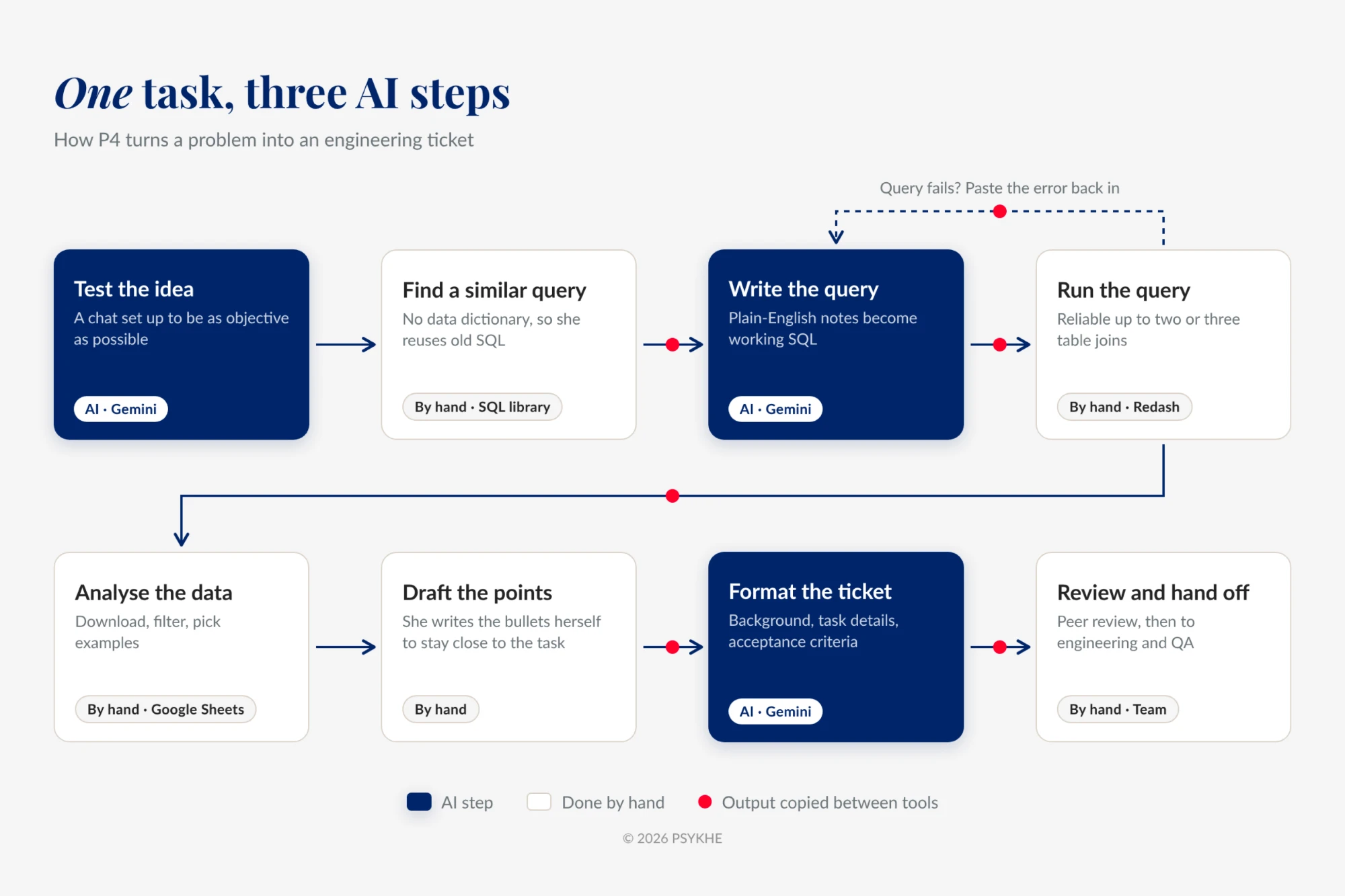
AI speeds up those three steps, but the job as a whole is no simpler. Most participants worked this way, and they put up with it because the AI step was still worth having. The cost shows up as lost time, which makes it easy to miss. A Stanford and BetterUp study of 1,150 US desk workers found 40% had received low-quality AI-generated work in the past month, costing nearly two hours each time to sort out.
"Saving five minutes on a draft is no saving if it adds ten minutes of checking."
A rough idea can be wrong. A number shown to stakeholders can’t be. Several participants found AI output needed substantial rework before they could use it, and one called AI-generated designs simply ‘not good’. The closer work got to final, the less AI helped.
The problem grows when knowledge isn’t written down. Much of the knowledge in finance and government work lives only in people’s heads. One participant learned a form’s rules by trial and error, because they were ‘not documented anywhere’. When context is missing, AI fills the gap with a guess.
Make the approved tool good enough to keep
If it can’t handle real work, people will find one that can. Find out what employees are trying to do and work out the risk. Then give them a way to do it. Regulatory has started to do so by asking companies to keep inventory of what people use. Singapore’s MAS expects financial institutions to identify AI use across the business and keep an accurate inventory, and GovTech is building a registry of AI agents for about 150,000 public officers.
Start with the workflow
Before deciding where AI fits, look at how the work gets done today. Then look for a step AI can remove, so it doesn’t become one more thing to manage.
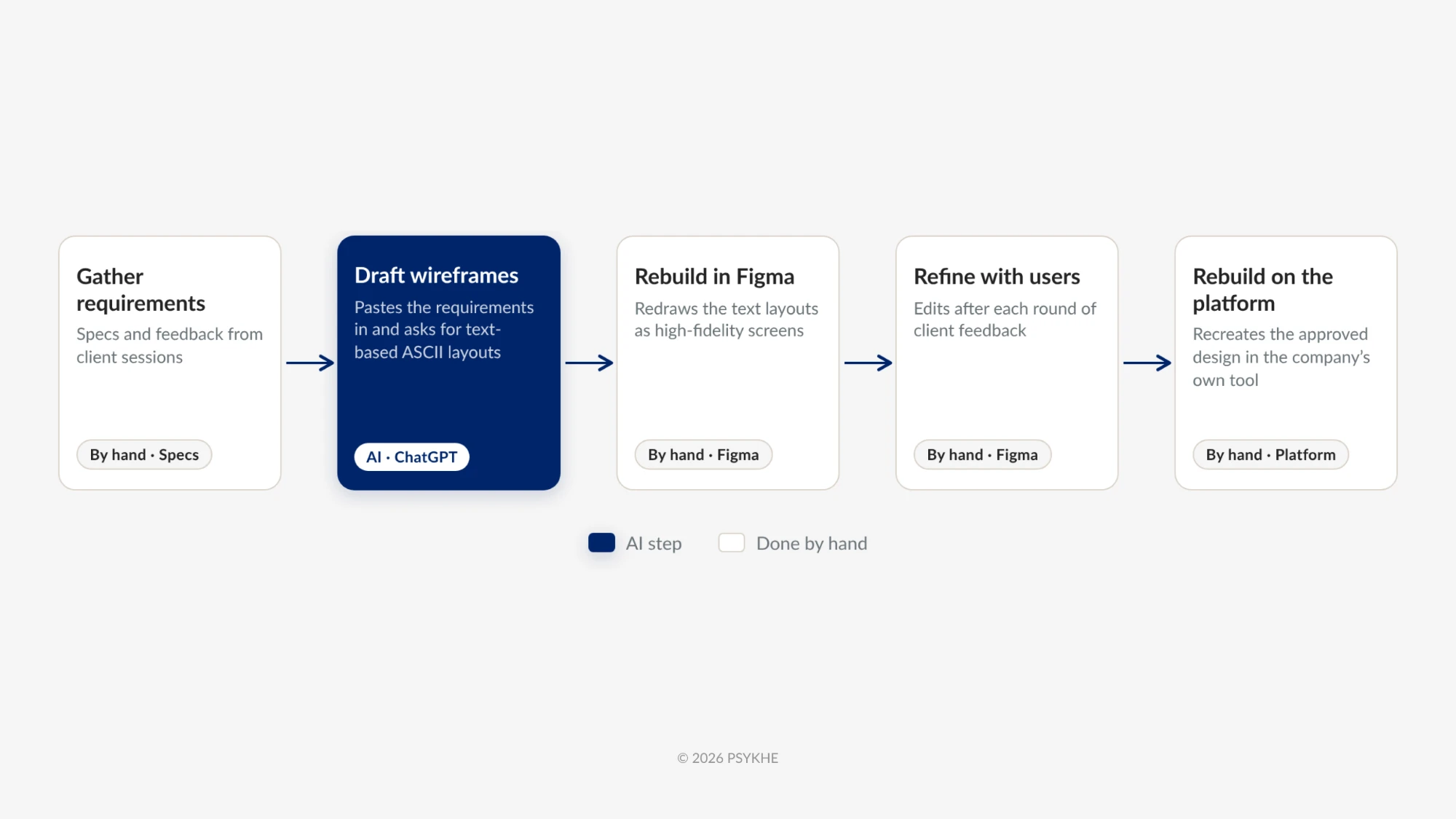
One designer we spoke to pastes requirements into ChatGPT to draft simple text-based wireframes. They then rebuild those wireframes by hand twice: once in Figma, and again on the company’s platform. AI that can read the requirements inside the design tool would remove both rebuilds.
Write down what the organisation knows
AI can’t use knowledge that only exists in people’s heads. Capturing business rules, exceptions, decision criteria, and terminology is part of getting ready for AI. Once it’s written down, connect AI to those sources and show which one each answer came from. That’s what lets people trust the output.
Make AI willing to disagree
Every participant checked AI output in some way. One stopped asking AI to check their work at all, because whenever they questioned an answer, it agreed and changed the answer to match. Anthropic’s research on five leading AI assistants found they consistently favoured responses that matched a user’s views over truthful ones, partly because people tend to prefer agreeable answers.
An AI that holds its position when the evidence supports it makes every check more useful.
The test of any AI tool is whether people will keep using it if nobody makes them. In our research, that came down to two things: output good enough for the job, and a tool someone else had paid for.
If your 2027 AI plan measures success by licences issued, you’re counting the wrong thing.
This article draws on 60-minute interviews conducted by PSYKHE in August and September 2026 with eight daily AI users working in banking, insurance, lending, government finance, and technology across Southeast Asia.